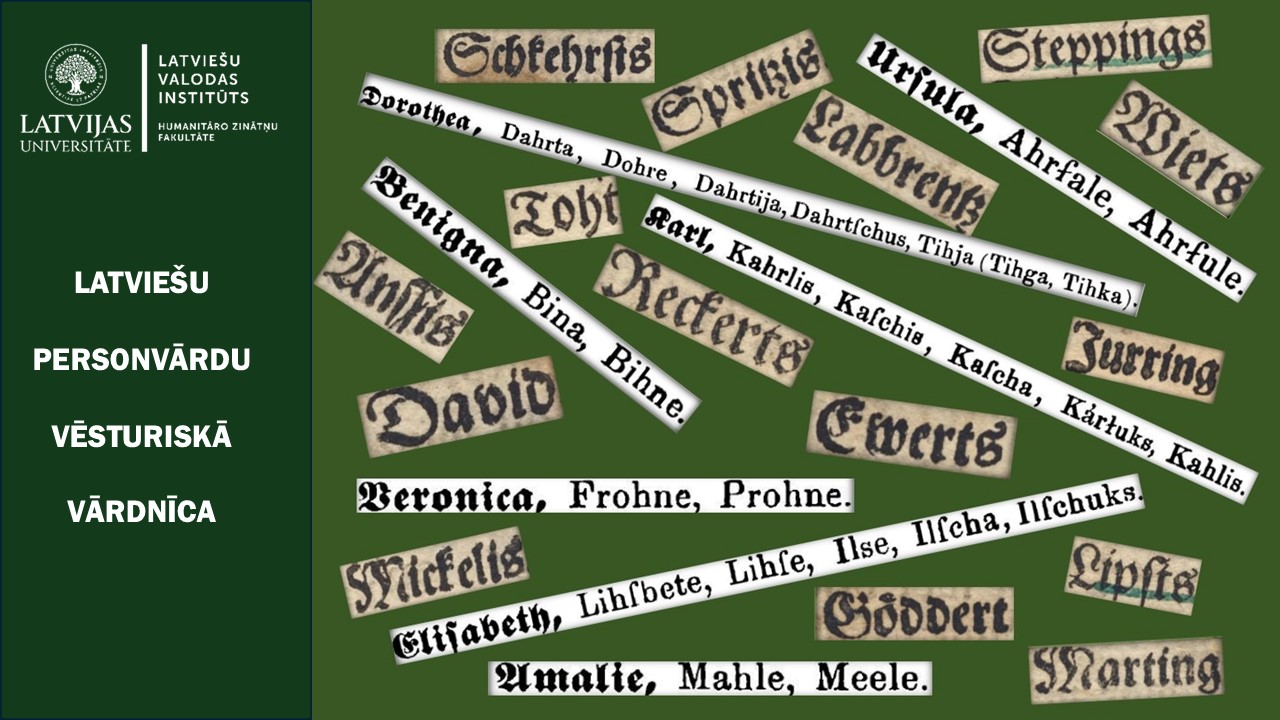
The electronic Historical Dictionary of Latvian Given Names (LPVV) has begun reaching its audience and is available at personvardi.lu.lv. The dictionary allows users to trace the development of Latvian given names from the 13th century onward, revealing the origins of personal names given to Latvians, their distribution across centuries, their earliest attestations in written sources, various spelling variants, shortened, adapted or modified forms, as well as the ways in which personal names arose and entered Latvia. At present, the first 200 entries have been published. The dictionary has been compiled by researchers from the Institute of the Latvian Language at the Faculty of Humanities of the University of Latvia under the leadership of Dr. philol. Renāte Siliņa-Piņķe. Authors of the dictionary: Renāte Siliņa-Piņķe, Sanda Rapa, Irēna Ilga Jansone, Ņikita Kazakevičs.
LPVV is a living dictionary that can be read already during its compilation process and will continuously be supplemented both with new entries and with data from new sources, while previously published entries will also be updated. Even now, however, it already contains, for example, such little-known given names as Bina, Tīķe, Kālis, and Kristīts.
Anna + Dārte = Andārte
LPVV entries are based on systematic research of sources from different centuries, including the collection and analysis of their data. Therefore, alongside the origin of a given name, the entries also present broader observations and conclusions about Latvian given names. For example:
compound names formed from two existing given names (Andārte, Marlīze, Saplīze) appear in Latvian around the mid-18th century, becoming more popular in the 19th century, when Latvian children were increasingly registered with multiple baptismal names;
the suffix –už– is considered an old diminutive-forming suffix known also in other Baltic languages (Prussian, Lithuanian) and productive in forming diminutive given names (Annuža, Baibuža, Māruža, Ievuža);
until the 19th century, several given names derived with the ending –iņš (Antiņš, Juriņš, Kristiņš, Lapiņš, Stepiņš, etc.) are attested; the linguist Jānis Endzelīns held that this ending developed from the suffix -in-, which originally did not necessarily have a diminutive meaning but rather indicated belonging or association, so at that time it likely did not yet carry a diminutive meaning.
Ķērsta – adapted in Latvian
The concept of “Latvian given names” is interpreted in different ways. In LPVV, Latvian given names are defined as all personal names recorded for Latvians and their ancestors in the territory of present-day Latvia. It is important to understand that Latvian given names are not only of Latvian or Baltic origin: borrowings – primarily from Hebrew, Latin, Greek, and Germanic languages– actually predominate.
Thus, the dictionary includes names of various origins, many of which were created, shaped, or acquired their distinctive phonetic form specifically in Latvian. For example:
Krišus – a shortened form created in Latvian from the Latin-derived name Kristians or, more likely, from one of its Latvian-adapted forms such as Krišans, Krišjānis (author of the Endtry: Sanda Rapa);
Ķērsta – a Latvian adaptation of the Middle Low German women’s name Kersten or Kerstin, ultimately based on the Latin name Christiana, transformed and shortened (author of the entry: Sanda Rapa).
Jurašs – not only a given name
LPVV includes both given names that remain popular in the 21st century (Elizabete, Dārta, Kārlis, Kristians) and names that are attested only in particular historical periods (Jurks, Šķērsta, Tenīss, Tonis). Some names are known only from dictionaries of earlier centuries (Dārčus, Dāpīts, Ģespers, Ortija), while others are attested in sources for only a single individual (Jurše, Juriks).
Many given names recorded in earlier centuries survive today only in surnames or place names. For example, the personal name Jurašs (author of the entry: Renāte Siliņa-Piņķe), known in the 17th–18th centuries, is no longer in use today but survives in surnames (Jurašs, Juražs) and in place names (farmsteads Juraši in Zasa and Aknīste parishes, the escarpment Juraša krasts in Grāveri parish, etc.).
Where are Jānis and Līga?
Some readers may be surprised not to find the names Jānis and Līga in LPVV at this stage, even though these were among the most frequently cited “most Latvian given names” in the 2020 campaign organized by the Latvian Language Agency. However, LPVV focuses on the diversity of Latvian given names across centuries and does not prioritise the inclusion of the most popular names (although we can confidently promise that Jānis and Līga will be included in due course).
The selection of the first entries was guided by several key factors to ensure the successful development of the dictionary’s conceptual framework and entry structure. As noted by Sanda Rapa, one of the authors of the entries, the name-family (nest) method significantly facilitates the compilation of historical dictionaries of proper names and reveals both deep structural tendencies in name usage and adaptation, as well as characteristics of specific periods and cultural layers. Therefore, the first entries include old but widespread names together with their related forms, forming name families – for example, the Latin-derived name Barbara, known in Latvia since the Middle Ages, along with its shortened, adapted or modified forms that initially even predominated among Latvians: Baba, Babe, Baiba, Baibale, Baibuža, Barba, Barbe, Bārbule, Bārbula (author of the entries: Sanda Rapa).
In the 18th century, Baiba – only in Courland
One of the most important theoretical questions in compiling LPVV was how to determine the principles for grouping variants within entries. To understand what information can be found in the dictionary, it is useful to look briefly at the structure of an entry.
The headword is usually given in modern spelling. The etymology section provides information on how the name entered or developed in Latvian, including the name from which the development chain began. Often several hypotheses are possible; they are presented in order of probability.
Diachronic distribution tables present all forms attested in the analysed sources, in their original orthography, indicating the year of attestation, region, source, type, and language. Thus, we learn, for example, that the name Kersten was recorded for Latvians from the 15th century in all Latvian cultural regions except Latgale; that Baiba in the 18th century is found only in Courland; and that Dārta in the 18th century appears as Darthe, Darte, Dahrte, Dahrta, while in the 21st century both Dārta and Dārte occur (author of the entries: Renāte Siliņa-Piņķe).
Entries also include information on the presence of names in Latvian dictionaries of the 17th–19th centuries and data on surnames likely derived from the given name in Latvian.
French Charlotte also in Latvia
Because LPVV is an electronic dictionary, it offers extensive search possibilities: users can search not only by the headword or part of it, but also filter by gender, language of origin, century, historical form, cultural-historical region, or related surname. For example, a search for 13th-century names currently returns six entries (Dabrelis, Dotis, Gailis, Nameisis, Varidots, and Viestarts – author of the entries Ņikita Kazakevičs), while for the 15th century five entries are available (Elizabete, Elzebe, Ilske, Ilzebe, Kersten).
When searching by language of origin, the results also include names that entered Latvian through that language or were formed in it. For instance, selecting “French” yields both the French-origin name Šarlote (introduced into Latvian in the mid-18th century via German) with its shortened forms Late, Loša, and Lote, as well as the shortened form Barba of the Latin-origin name Barbara, which in the Middle Ages was especially characteristic of regions of France and Switzerland.
When answering the question “How many given names do Latvians have?”, Ojārs Bušs once noted that only hypotheses are possible, because it is no longer possible to fully reconstruct the complete set of names from past centuries. Although LPVV will not be able to include absolutely all historical names, it will serve as an excellent platform where anyone can obtain information about a personal name of interest—and likely discover at least one previously unknown or unnoticed name.
The dictionary is intended for a wide audience: linguists (especially researchers of personal names), historians, genealogists, local history researchers, and anyone interested in Latvian given names and their history.
Ilze Štrausa
Scientific Assistant of the Latvian Language Institute, UL FH