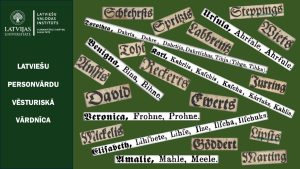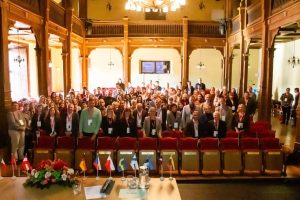
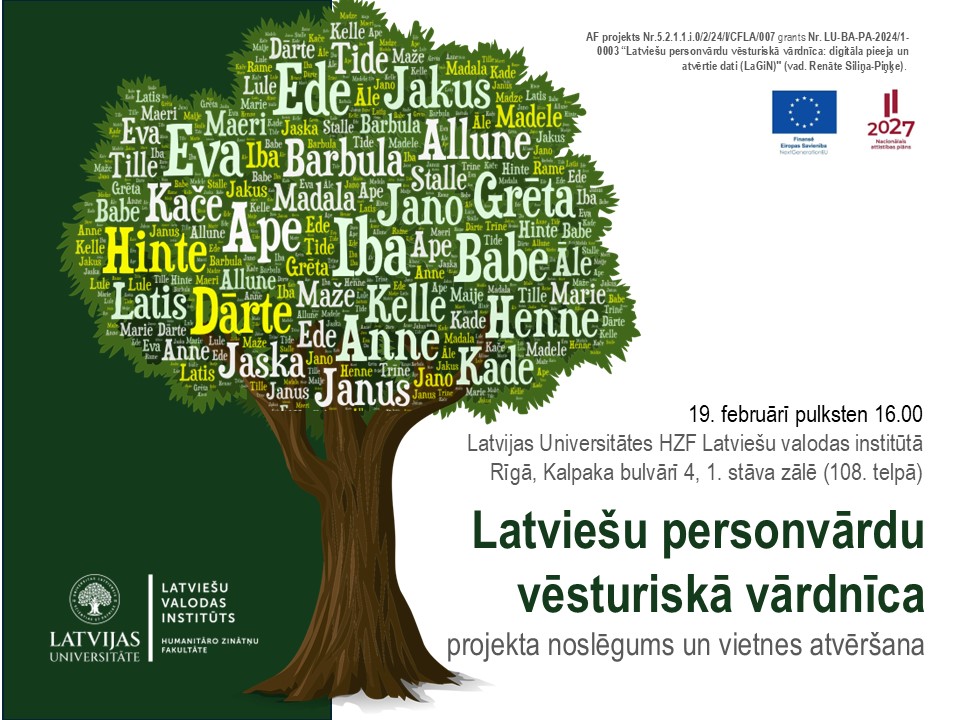
On 19 February 2026 at 16:00, at Kalpaka Boulevard 4 in Riga, the Latvian Language Institute will present the electronic Historical Dictionary of Latvian Personal Names (LPVV), developed over the past year with dedication and enthusiasm.
On the opening day, the first 200 entries of the dictionary – developed within the LaGiN project under the leadership of Renāte Siliņa-Piņķe – will be made available to the public.. The dictionary allows readers to trace the origins and historical development of Latvian personal names, from entries recorded in 13th-century chronicles to 18th-century parish registers, while also offering a glimpse of how these names are distributed in Latvia today. Each entry presents the earliest documented use of a name, its regional spread, spelling variants, linguistic origin, and historical development.
Even at this early stage, the dictionary reveals how rich and dynamic the history of Latvian personal names is. Alongside familiar modern names, historical sources contain many that have disappeared or survive only in surnames today, such as Andārte, Babe, Jaspers, Kriškjānis, Ķestens, Saplīze, Šķērstens, and Tenīss. Some names have been so thoroughly adapted into Latvian that their original form is no longer easily recognisable without research – for example Baiba and Šķērsts. Others illustrate the remarkable flexibility of dialects and name formation in Latvian, such as Dārčus, Ilžuks (feminine names), Baibuža, Binne, and Ortija. And there are names that reflect a distinctly Baltic heritage, such as Nameitis, Dotis, and Gailis.
The dictionary is intended for researchers, genealogists, local historians, and anyone interested in the stories behind Latvian names. It will be a freely accessible digital resource with extensive search possibilities and will continue to expand each year, gradually building a fuller picture of the history of Latvian personal names. LPVV is designed as a living, dynamic dictionary, available already during its development and regularly updated with new entries and source material.
At the launch event, visitors will have the opportunity to explore the newly published dictionary, meet its authors (Renāte Siliņa-Piņķe, Sanda Rapa, Ilga Jansone, Ņikita Kazakevičs) and editors (Anta Trumpa, Laimute Balode), and take part in educational activities and interactive games related to personal names.

Sanda Rapa
Sennior researcher, Latvian Language Institute, UL FH