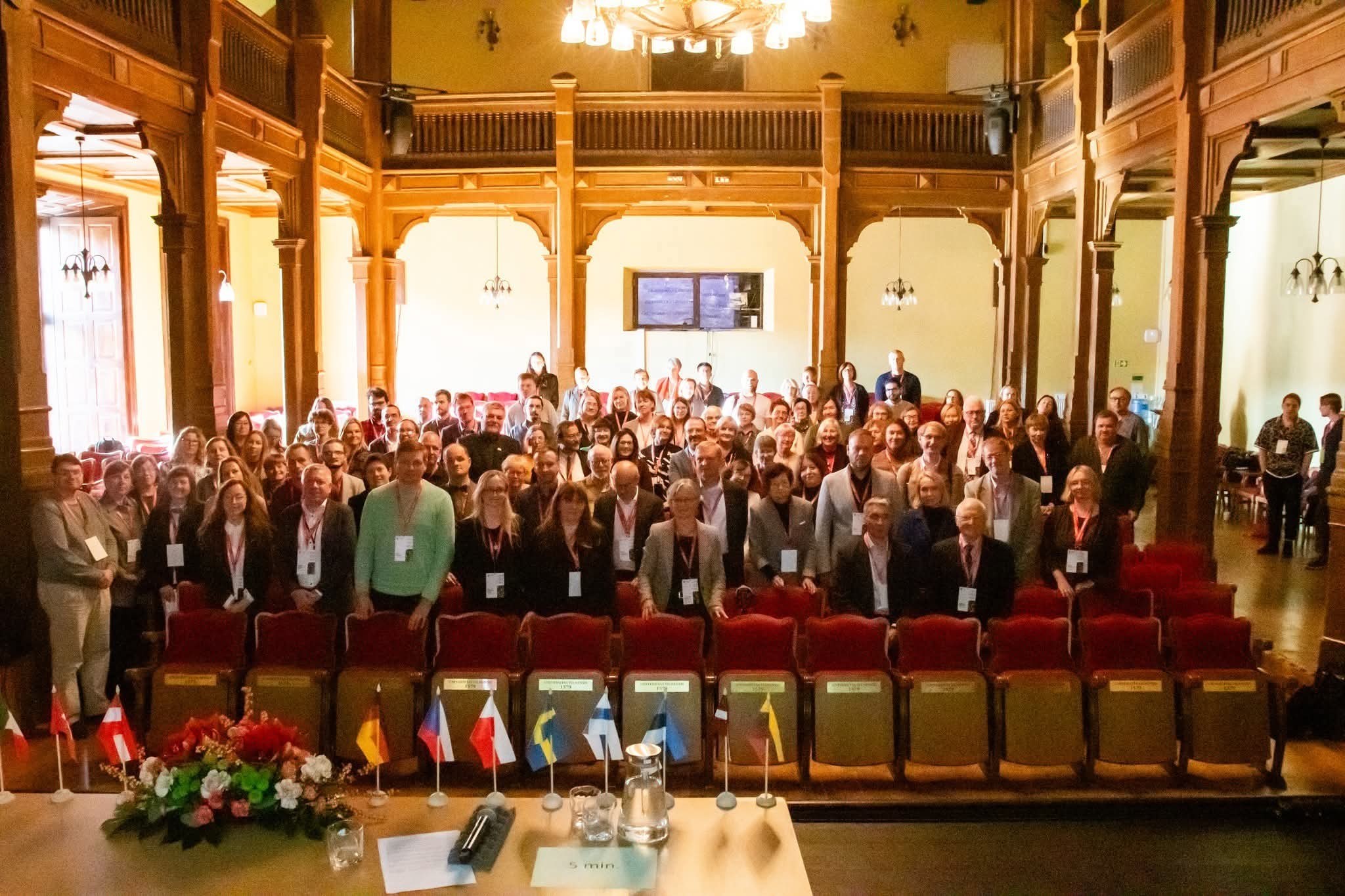
Foto: Viļņas Universitātes Baltistikas katedra (Vilniaus Universitetas, Baltistikos katedra)
From 21 to 25 October 2025, Vilnius University hosted the long-awaited global gathering of Balticists – the 14th International Congress of Balticists. The tradition of the Congress was established in 1965 and has since been held every five years, alternately in Latvia and Lithuania. This time, participants travelled to Lithuania, where more than 170 scholars from Latvia, Lithuania, Estonia, Italy, Germany, Poland, Finland, Sweden, the Czech Republic, Austria, France, Switzerland, the Netherlands, the United Kingdom, the United States, Finland, and Japan came together.
The Congress was organised into nine sections: “Current Topics in Baltic Phonetics and Phonology”; “The Tradition and Perspective of Baltic Onomastic Research”; “Baltic-Language Digital Resources in Grammar Research”; “Digital Approaches to Old Baltic Linguistic Monuments”; “Latgalian and Other Regional Varieties of the Baltic Languages: Interdisciplinary Solutions and Research Opportunities”; “Meaning in Baltic Languages: A Cognitive Perspective”; “Prosody and Segments in Baltic Comparative Grammar”; “At the Intersection of Historical Morphology and Syntax: The Baltic Verb from a Diachronic Perspective”; and the “General Section”.
From the Institute of the Latvian Language, Faculty of Humanities, University of Latvia, eleven researchers participated in the Congress: Laimute Balode, Māris Baltiņš, Anna Frīdenberga, Regīna Kvašīte, Anete Ozola, Sanda Rapa, Renāte Siliņa-Piņķe, Anna Stafecka, Anta Trumpa, Pēteris Vanags, and Anna Vulāne.
In the section “Digital Approaches to Ancient Baltic Language Sources”, papers were presented by Anta Trumpa and Anna Frīdenberga.
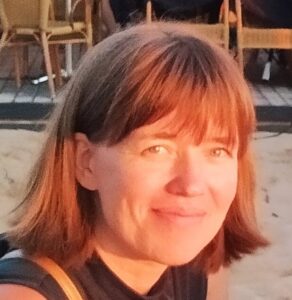
ANTA TRUMPA presented the paper “Dar kartą apie Georgo Elgerio žodyną ‘Dictionarium Polono-Latino-Lottauicum’ (1683)” (“Once Again on Georg Elger’s Dictionary Dictionarium Polono-Latino-Lottauicum (1683)”). At the beginning of her presentation, she introduced the modernisation of the corpus of Early Latvian texts SENIE, in which all texts included in the corpus are converted into modern orthography to facilitate corpus searches. The extensive set of conversion rules developed for Elger’s dictionary prompted the author to conduct a focused study of its orthographic and lexical features. Trumpa concluded that the orthography of Elger’s dictionary partly corresponds to that of his 1621 hymnbook—widely studied due to its distinctive representation of vowel length—yet the dictionary itself contains numerous inconsistencies. She also provided further evidence for earlier observations that the dictionary primarily reflects the lexicon of Vidzeme, Latgale, Sēlija, and partly Zemgale, while western Latvia is less represented. This study serves as an encouragement to continue research on Elger’s dictionary, whose lexical richness has not yet been fully appreciated.
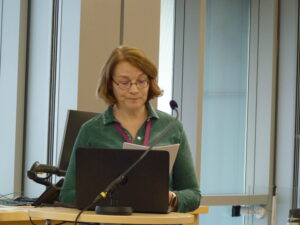
ANNA FRĪDENBERGA delivered a paper entitled “The Distinction between Compounds and Word Combinations: One of the Problematic Issues in Compiling the ‘Historical Dictionary of the Latvian Language’”. During the preparation of the Historical Dictionary of the Latvian Language (HDLL), various methodological challenges arise and are discussed within the dictionary working group. One such challenge concerns the distinction between compounds and word combinations. Early texts frequently display variation between solid and separate spelling when both components are nominal in nature. For example, formations such as asinanauda ‘blood money’ or padomadevējs ‘advisor’ may occur either as single words or as separate words and can thus be interpreted as compounds or word combinations. Moreover, early texts often employ a linking sign, as in gaisa=grābējs or sirds=sāpes. In some cases, it is not possible to draw a strict boundary between a stable compound and a phrase. Consequently, alternative solutions are possible: such formations may be treated as separate dictionary entries (with the compound as the headword) or included under one of the components as a word combination. The HDLL authors have agreed on several criteria to guide these decisions. Semantic stability is particularly important: a compound is favoured if the word precisely denotes a specific object or concept (or functions as a term). Accordingly, items such as bada=dzeguze ‘hoopoe’ and kumeļa=pēdi ‘coltsfoot’ are treated as separate entries. As the work on the dictionary spans a long period, practical experience develops alongside the excerpted material, and in many cases multiple classifications remain possible.
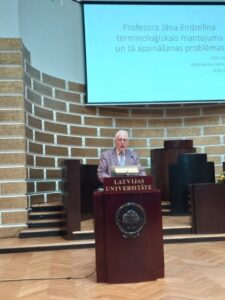
In the General Section, MĀRIS BALTIŅŠ spoke about one of the most significant contributions of Jēkabs Velme (1855–1928) to Latvian cultural development—the founding and editing of the first long-running Latvian journal Austrums (1885–1906), which he edited for 18 years. From issue 3 (1885) to issue 12 (1888), the journal published a conceptually unified series of twelve articles entitled “Letters on Language and Linguistics”, regarded as the first presentation of the basic principles of general linguistics in Latvian in a literary-public journal. Written in an academically popular style and spanning 4–7 pages each, the letters can be divided into thematic cycles. The first addresses fundamental questions, including “What is language?”, “How do we acquire language?”, and the relationship between language and thought. The second focuses on language change, discussing linguistic vitality, changes in word form and meaning, and the emergence of names for objects and concepts. The third explores linguistic similarity and diversity, introducing concepts such as language family, dialect, and subdialect, with particular attention to Indo-European and other language families. The final letter offers a synthesis of the preceding discussions. Velme himself modestly stated that he had merely wished “to point out the most important matters and thereby explain, to some extent, what language is and what significance it holds among people”, presenting only what “the majority of linguists agree upon”.
In the section “Current Issues in the Phonetics and Phonology of Baltic Languages and Dialects”, Anete Ozola and Edmunds Trumpa presented their research.
ANETE OZOLA delivered a paper entitled “Stress in Prefixed Verbs in the Livonian Dialect of Courland”, analysing stress patterns in these dialects and comparing them with standard Latvian and other dialectal systems. She demonstrated that in prefixed verbs within the Livonian dialect area, stress often falls on the second syllable, in contrast to the generally accepted initial stress in Latvian. Acoustic studies confirm this observation, revealing differences in intensity and relative duration between prefix and root. Based on recordings of connected speech, Ozola showed that intensity is the most reliable indicator for identifying this type of stress. The paper offered new insights into phonetic variation in Courland dialects and highlighted the need to refine stress descriptions in the context of the Livonian dialect.
EDMUNDS TRUMPA presented the paper “Automated Data Processing and Phonetic Analysis of Connected Speech as an Alternative to the Minimal Pair Method in Research on Baltic Languages and Their Dialects”. He critically assessed the traditional minimal pair method, which, despite its precision and reproducibility, is limited by a small number of examples and artificial language use. Trumpa demonstrated how automated tools (Praat, MS Excel, and VBA scripts) can be used to analyse recordings of natural speech—conversations, narratives, and similar material—yielding visual data on vowel quality, intensity, duration, and other parameters. This method relies on large sets of allophones rather than isolated minimal pairs and enables comparisons across speakers, dialects, and even historical recordings. The presentation emphasised that this approach broadens the scope of phonetic research by offering a more natural and widely applicable alternative to classical experimental methodologies.
In the section devoted to Latgalian studies, papers were presented by Anna Stafecka and Anna Vulāne.
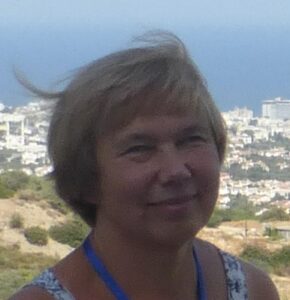
ANNA STAFECKA presented the paper “Mid-19th-Century Latgalian Written Language: Dialect, Norm, and Tradition”, continuing her research on the Latgalian translation of biblical stories published in Tartu in 1860 (reissued in 1861), Nutykszonas Biblias aba Izstostiejszona Waca un Jauna Istodiuma…, attributed to the German-Baltic/Polish publicist, historian, ethnographer, and folklorist Gustav Manteuffel (1832–1916). The presentation focused on the tradition of spontaneous normativism in Latgalian written language and the influence of dialects. Stafecka argued that the translation continues the spontaneous normativist tradition established in 18th- and 19th-century Latgalian written sources, primarily based on South Latgalian dialects, while Manteuffel’s work also introduced features of Central Latgalian dialects. Analysis of dialectal features suggests that some characteristics point to possible collective authorship of the edition.
ANNA VULĀNE presented the paper “The Terminology of Anton Skrinda’s ‘Latwìšu wolúdas gramatika’ (1908)”, examining the first grammar of Latgalian and its significance in the history of Latgalian orthography and language standardisation. The paper demonstrated how, following the lifting of the ban on Latin script, Latgalians began developing their own written language and teaching materials, and how Anton Skrinda laid the foundations for orthographic and grammatical development through a work intended for the St Petersburg Theological Seminary. The study analysed 167 terms used by Skrinda and their synonyms, many of which differ from modern Latgalian usage but reveal early efforts to shape Latvian grammatical terminology. Despite deviations from everyday language, Skrinda’s terminology influenced later discussions on writing standards and provides valuable insight into the development of Latgalian in the early 20th century.
In the Onomastics section, one of the most well-attended, papers were presented by Laimute Balode, Renāte Siliņa-Piņķe, and Sanda Rapa.
The topic “Double Surnames and Double Given Names in Latvia” was addressed by LAIMUTE BALODE (Institute of the Latvian Language, University of Latvia) and Pauls Balodis (University of Helsinki). Double personal names have long remained a peripheral research topic. Drawing on historical documents and contemporary name lists, the presentation examined their historical development, current trends, and legal aspects. A double given name—two names combined into one official name—reflects diverse naming motivations. Double surnames – the combination of two surnames – constitute an important phenomenon in anthroponymy, intertwining issues of heritage and identity. The first part of the presentation traced the history of double given names in Latvia since the 18th century. Data from newborn name lists in the 21st century confirm a growing trend: between 2021 and 2023, more than half (~52%) of Latvian newborn name lists included double names; approximately 13% of newborns were given two names (in exceptional cases, contrary to the law, around 1% were given three names, mostly children born abroad). Clear tendencies were identified: the second name often signals ethnic identity and is frequently inherited within families; name pairs may be coordinated by initial letter, sound, or semantics; or a rare, original, or newly created name may be chosen. Changes in double names over the past 20 years were also analysed. The second part focused on double surnames, discussing their origins, formation patterns, and historical prevalence. Records from the 1920s and 1930s show that double surnames were once more common, though many individuals later abandoned them. In 2020, approximately 11.6% of Latvia’s population bore double surnames. A new, sporadically observed trend was also noted, whereby spouses exchange surnames by adding their own surname to that of their partner.
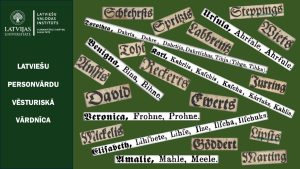
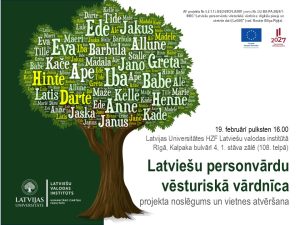
RENĀTE SILIŅA-PIŅĶE, together with ILGA JANSONE, presented the paper “The Diversity of Personal Name Forms in the Context of Compiling the ‘Historical Dictionary of Latvian Personal Names’”. The presentation introduced the dictionary’s concept, progress, and first completed entries. Three groups of problematic cases were analysed in detail, each crucial for ensuring the quality and systematic nature of the dictionary. Both theoretical and practical challenges were discussed, particularly the unification of name variants within a single entry, given that the dictionary’s sources span long periods and multiple languages. Siliņa-Piņķe examined differences in spelling and pronunciation, especially vowel length variation, the use of ie, and the development of the diphthongs aj/aij, highlighting early orthographic inconsistency, dialectal influence, and language change. These examples underscored the need for clear criteria to ensure a consistent methodological approach and illuminated the scientific and methodological challenges of the LPVV project.
SANDA RAPA presented the paper “Anthroponymic Nests of 18th-Century Given Names: The Case of Lejasciems”, addressing theoretical and terminological issues of anthroponymic nest analysis, illustrated through 18th-century parish records from Lejasciems. The presentation demonstrated how this method enables a systematic and in-depth analysis of historical personal-name material, revealing linguistic and cultural processes that shaped name development. Focusing on the identification of archionyms and the classification of their variants, the approach allows for the study of adaptation and derivation patterns as well as sociolinguistic factors influencing name variation. The analysis showed that variation was driven by unstable orthography, multiple borrowing and localisation pathways, and parallel adaptation from different sources. From a diachronic perspective, the study revealed the gradual stabilisation of the personal-name system, including the consolidation of endings, phonetic adaptation to Latvian, and changes in naming fashions influenced by language contact, religious factors, and social traditions. Such studies not only help reconstruct the development of Latvian personal names but also highlight language as a key carrier of cultural identity.
PĒTERIS VANAGS delivered a plenary lecture entitled “Georg Mancelius’ Lettus (1638): Sources and Influences”, analysing the sources and structure of Mancelius’ dictionary Lettus (1638) and situating it within early modern lexicographic traditions. Vanags demonstrated that the German lemma list is based on Heinrich Decimator’s Sylva vocabulorum (1578) and the anonymous Lexicon trilingue (1586), while the Phraseologia Lettica and the ten appended dialogues testify to Mancelius’ original contribution -texts adapted to the local linguistic and cultural context. The presentation emphasised Mancelius’ importance in the development of Latvian lexicography and positioned his work as a bridge between European lexicographic traditions and the emerging Latvian written language.
On behalf of the Faculty of Humanities, University of Latvia, the Institute of the Latvian Language extends its sincere thanks to colleagues at Vilnius University for the excellent organisation of the Congress.
More about the Congress: website of the Vilnius University.
Sanda Rapa
LU HZF Latviešu valodas institūta vadošā pētniece
Anta Trumpa
LU HZF Latviešu valodas institūta vadošā pētniece
Māris Baltiņš
LU HZF Latviešu valodas institūta vadošais pētnieks
Anna Frīdenberga
LU HZF Latviešu valodas institūta pētniece
Anna Stafecka
LU HZF Latviešu valodas institūta vadošā pētniece
Laimute Balode
LU HZF Latviešu valodas institūta vadošā pētniece