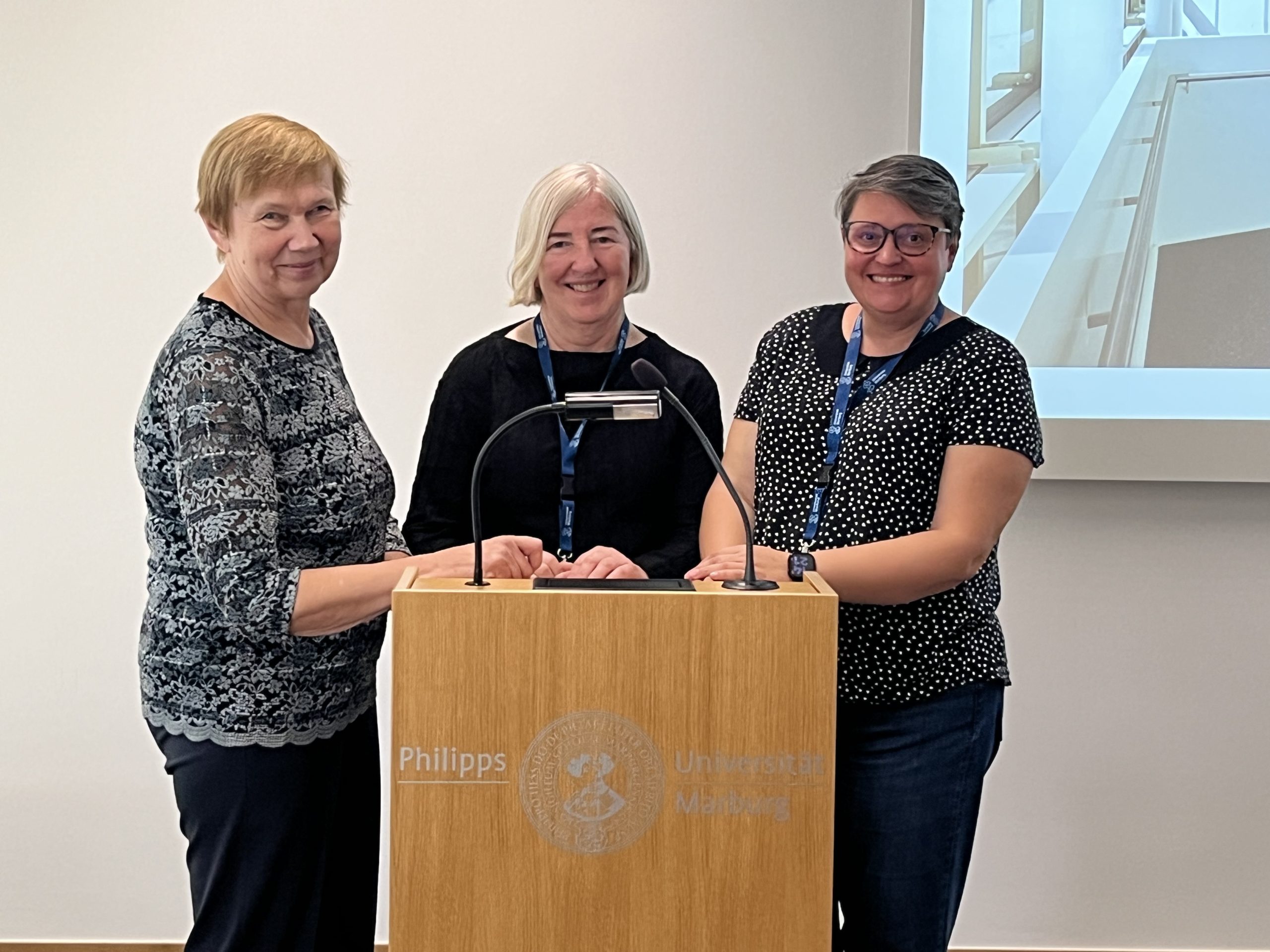
From 7 to 11 September 2026, leading researchers at the Institute of the Latvian Language of the University of Latvia, PhD Anna Stafecka and PhD Liene Markus-Narvila, together with researcher PhD Regīna Kvašīte, participated in the 11th Congress of the International Society for Dialectology and Geolinguistics, held in Marburg, Germany. The congress was organised by the Research Centre of the German Language Atlas (Forschungszentrum Deutscher Sprachatlas) at the University of Marburg. Approximately 120 scholars from 33 countries around the world took part in the congress.
The overarching theme of the congress was Geolinguistics across Borders. Its aim –creating fruitful and sustainable cooperation and exchange of ideas in all topics on dialectology and geolinguistics.
The congress was opened by Alfred Lameli, Director of the Research Centre of the German Language Atlas, who welcomed all those present and introduced the history of the institute and the University of Marburg. In his address, the professor highlighted the research centre’s 150 years of experience in the study and documentation of linguistic variation and emphasised the significance of the congress theme, underscoring the role of borders as spaces of contact, interaction and language change. It was noted that contemporary geolinguistics must take into account both mobility and technological development, as well as the historical and local dimensions of linguistic diversity.
Manuela Nevaci, President of the International Society for Dialectology and Geolinguistics, emphasised the society’s importance for the development of dialectology and geolinguistics, as well as the topical relevance of the congress theme. It was noted that contemporary linguistic variation is significantly influenced by mobility, multilingualism, digital communication and transnational interaction; consequently, traditional research perspectives need to be reconsidered. The congress was characterised as an international forum for the exchange of ideas, the discussion of innovative approaches, the development of cooperation and the search for new perspectives in the study of linguistic variation. It was also described as a meeting place for different academic generations, fostering dialogue between tradition and modernity. The President of the society also emphasised that the study of dialects is not a job but a duty of honour.
Thomas Nauss, President of the University of Marburg, also addressed the congress, highlighting the importance of researching language – particularly dialects – in today’s globalised world.
The congress presentation sessions took place over four days, each day beginning with plenary lectures. The plenary speakers were Carlota de Benito Moreno, who focused on the dynamics of variation in the Western Canary Islands; Nikola Vuletić, who examined geolinguistic experiences and perspectives in the Istrian Peninsula; Barbara Plank, who spoke about human-centred large language models for inclusive language technologies; and Eivind Nessa Torgersen, who addressed processes of phonetic change in London English.
The academic programme was organised into several parallel sections covering a range of topics related to dialectology and geolinguistics: geolinguistics across borders; dialect and society; lexicon; dialect sources – texts, dictionaries, atlases and corpora; the history of geolinguistics and dialectology; syntax; morphology; digital approaches to dialectology and geolinguistics; phonetics and phonology; and pragmatics.
The congress also included a meeting of the International Society for Dialectology and Geolinguistics, as well as elections for the society’s president and council. Manuela Nevaci of Romania was re-elected President of the society. Words of thanks were expressed to Astrid van Nahl, editor of the society’s publication „Dialectologia et Geolinguistica”, for more than 20 years of service in that position. Joachim Steffen, Professor at the University of Augsburg, was elected as the new editor. His principal research interests include multidimensional linguistic geography, language contact and corpus linguistics, among other areas.
The next congress is scheduled to take place in Turin, Italy, in 2029.
In her presentation, „Dialect and the Standardised Language in Latgale,” Anna Stafecka focused on the varieties of the Latgalian dialect and the Latgalian written, or standardised, language that developed on their basis, as well as on the complex course of its development. Several terms used to designate the Latgalian written language were also analysed. It was emphasised that the Latgale region is home to varieties of the High Latvian dialect of Latvian, together with its historically developed Latgalian written language. The interaction between the local varieties and the written language was characterised, and it was established that the use of the written language in the cultural and spiritual spheres has also contributed to the preservation of the local varieties. The current status of the Latgalian written language, as well as measures for its protection and further development, which are stipulated by the State Language Law, were also examined.
Regina Kvašyte’s presentation, “Contemporary Dialect Lexicography in Lithuania and Latvia,” examined dictionaries of territorial varieties of language, the publication of which began in both Lithuania and Latvia in the 1970s. To date, six such dictionaries have been published in Latvia and 20 in Lithuania.
It was established that the diversity of terminology used in the two languages is reflected in the titles of the dictionaries. In Latvian, only the term izloksne is used, whereas in Lithuanian the term šnekta (or the plural šnektos), denoting a smaller territorial unit, is more common. However, the native synonym tarmė for the loanword dialektas is also relatively widespread, although it is not entirely precise.
Attention was also drawn to the fact that Lithuanian and Latvian linguists hold differing views on dialectological publications: some regard them as general dictionaries, while others classify them as specialised dictionaries. On the basis of the lexical material included, dialect dictionaries in both languages are divided into comprehensive and differential types. The authors of individual publications often describe their type in the introduction, although this is not done in all cases.
In her presentation, “The Varieties of Lower Kurzeme through the Ages,” Liene Markus-Narvila examined the study and contemporary significance of the varieties spoken in Lower Kurzeme. The principal characteristics of these varieties were described, with particular attention to their phonetics, grammar and distinctive vocabulary. It was emphasised that the varieties of Lower Kurzeme are diverse and that some of their oldest characteristic linguistic features have survived sporadically to the present day. Dictionaries dating from the 17th and 19th centuries and the most significant early 20th-century studies of the varieties of Lower Kurzeme were discussed. These studies focused primarily on the phonetics, grammar and lexicon of individual local varieties, and were fragmentary in nature, failing to cover the entire territory of Lower Kurzeme.
The presentation also noted that traditional dialect features continue to occur in the speech of different generations, including in everyday informal communication. The possibility that a regional speech variety, or regiolect, is emerging in Lower Kurzeme was considered. This variety occupies an intermediate position between the traditional dialect, colloquial language and the standard language. It was concluded that the study of the varieties of Lower Kurzeme is important both for preserving Latvia’s linguistic diversity and for safeguarding its cultural and historical heritage. At the same time, it was emphasised that broader and methodologically coherent studies are needed in Latvia in order to determine more precisely the development, distribution and boundaries of the possible Lower Kurzeme regiolect.
The research topics are being developed within the framework of the National Research Programme „The Latvian Language in Time, Space and Society” (LATS, No. VPP-LETONIKA-2025/1-0012).
Anna Stafecka’s and Liene Markus-Narvila’s participation in the congress was financially supported by the State Culture Capital Foundation and the Faculty of Humanities of the University of Latvia.
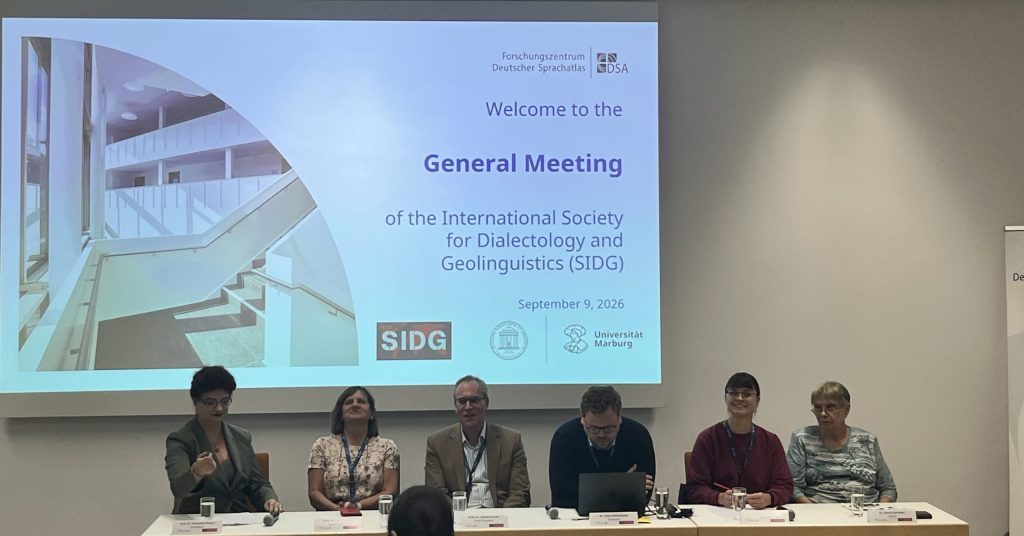
General Meeting and Elections of the International Society for Dialectology and Geolinguistics. Photo: Liene Markus-Narvila
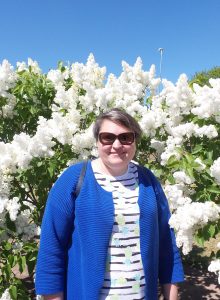
Liene Markus-Narvila
Senior Researcher, Latvian Language Institute
Anna Stafecka
Senior Researcher, Latvian Language Institute
Regīna Kvašīte
Researcher, Latvian Language Institute