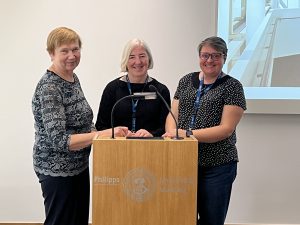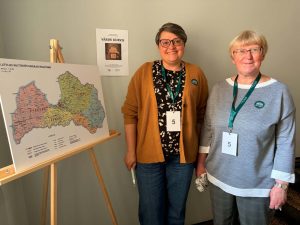
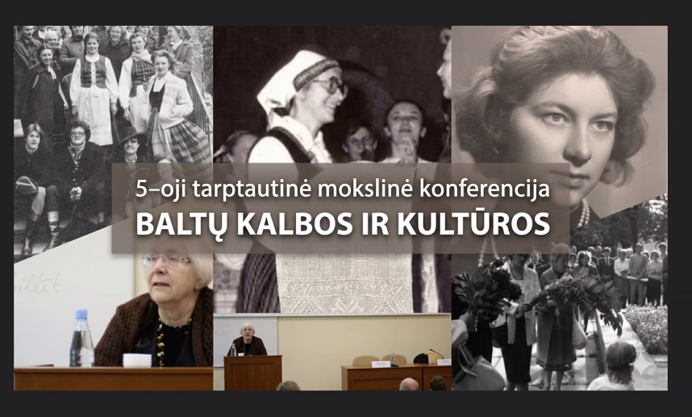
On 18–19 June 2026, the Faculty of Social Sciences and Humanities at Klaipėda University hosted the 5th International Scientific Conference Baltic Languages and Cultures, dedicated to the 55th anniversary of Lithuanian Studies in Klaipėda and to the memory of Professor Habil. Dr. Audronė Jakulienė-Kaukienė on the occasion of her 85th birthday. The Institute of Latvian Language was represented by leading researchers Laimute Balode, Ilga Jansone, and Regina Kvašytė. Their participation was supported by the Latvian National Research Programme project “Latvian Language in Time, Space and Society” (No. VPP-LETONIKA-2025/1-0012).
The plenary papers on the first day reviewed the beginnings of Baltic studies in Klaipėda and highlighted Professor Audronė Kaukienė’s invaluable contribution to the field. Many of her former colleagues and students shared heartfelt memories of her as an outstanding teacher, ethnologist, gifted folklorist, and performer of Lithuanian folk songs. She is remembered for her often-quoted saying: “The verb is the heart of language.”
The conference featured 37 presentations delivered by 40 participants from Lithuania, Latvia, Italy, Germany, Romania, and Finland. The programme was organised into several thematic sections corresponding to Professor Kaukienė’s principal research interests. The presentations focused on the following topics:
- Baltic languages and dialects;
- Cultural, historical, and archaeological phenomena;
- Written and bibliographic monuments;
- Baltic mythology and ethnographic heritage.
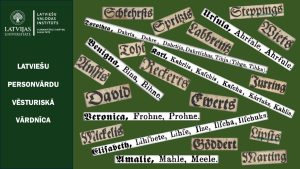
During the closing plenary session, Laimute Balode and Ilga Jansone, leading researchers at the Institute of Latvian Language, University of Latvia, presented a paper on the types of variation in Latvian personal names from both diachronic and synchronic perspectives.
Variation in Latvian personal names has existed throughout all historical periods; however, it has never been systematically studied from either a theoretical or an empirical perspective. Name variation is regarded as an inevitable phenomenon associated with language change, regional (dialectal) differentiation, and the sociocultural context. In anthroponymy, it is particularly complex because it reflects the interaction of systemic (linguistic), normative (institutional), and individual (name-bearer) variation.
The paper examined the principal types of name variation – including historical, phonetic, graphic, morphological, hypocoristic, normative, and other variants – with particular attention to phonetic, graphic, and morphological variation. From a diachronic perspective, the concept of variation is complicated by the unknown historical pronunciation of names and by possible graphemic variants (e.g. the 18th-century forms of the stem Andr– : Andreas, Andres, Andrees, Andrex, Andrek, Andrest, Andreus, Andriks, Andrin, Andrins, Andr, Andre, and Andris). The largest group consists of phonetic variants involving differences in vowel quantity or quality (e.g. historical Ernſts/Eernſts; modern Arturs/Artūrs, Daniels/Dāniels), consonantal alternations (historical Ilſe/Ilſche, Lihſe/Lihſche; modern Genovefa/Genoveva, Henriks/Henrihs, Zigrīda/Sigrīda), and consonant doubling in loan names that often reflects the spelling of the source language (e.g. Gabriela/Gabriella). The second largest group comprises morphological variants (masculine names ending in -s/-is: Aleksis/Alekss; feminine names ending in -a/-e: Katrīna/Katrīne). Differences in stem forms are associated with the adaptation of borrowed names from other languages and, in some cases, with dialectal influence (e.g. Oļģerts/Aļģirts/Aļģirds, Rihards/Ričards/Rišards). Quantitative data from the Office of Citizenship and Migration Affairs demonstrate the competition between variants: traditional forms are generally preferred, although their normative status does not always correspond to their actual frequency of use.
Among the presentations of greatest interest to Baltic onomasticians were Jūratė Laučiūtė’s paper “That Endless Baltic World”, in which she proposed several new Baltic etymologies for Russian place names (including the hydronym Irpen < Baltic Airupine and Kempa < Lithuanian Kempė < kempti ‘to dry up, wither; harden’); Dalia Kiseliūnaitė’s presentation on Vilis Pėteraitis’ place-name survey; Adriano Cerri’s (University of Pisa) paper on the onomastic system of Kristijonas Donelaitis’ The Seasons, in which he discussed the theory of literary onomastics and the typology of proper names (Cerri has also translated and published The Seasons in Italian); Vytautas Rinkevičius’ (Vilnius University) presentation on newly discovered archival materials from Ukraine concerning the scholar Viktor Petrov (1894–1969), his unfinished grammar of Old Prussian, and theonyms, mythonyms, and other proper names preserved in the manuscript; and Aistė Šiaulytė’s (Klaipėda University) study of Klaipėda street names and ideological reflections in twentieth-century urbanonyms.
The Institute of Latvian Language was also represented by researcher REGĪNA KVAŠYTĖ, whose presentation examined translations of Latvian fiction into Lithuanian. She noted that approximately 120 books had been translated between 1990 and 2025 and paid particular attention to the translation of book titles, highlighting both successful solutions and cases of misunderstanding.
The conference provided an important forum for discussing the principal markers of cultural identity – language, national and civic consciousness, historical and cultural heritage – their interaction, functions, and values, as well as the challenges posed by globalisation and the current geopolitical situation.
Laimute Balode
UL FH Latvian Language Institute senior researcher